It was a couple of hours before Donald Trump promised to bomb Iran back to the Stone Age that humanity did something extraordinary.
Under an eruption of blinding white steam and churning orange fire, hundreds of tons of metal and four intrepid humans were thrust into space.
The launch of Artemis II is the culmination of decades of toil and strife, of ambition and expectation, of engineering and scientific progress. It is the manifestation of a renewed desire for humans to step out beyond the world we know, into the darkness of the solar system. Artemis II will orbit the moon and then come home. The next iteration will land on the surface of the moon. From there, the plan is to establish a base. It’ll be used to conduct scientific experiments and as a hub for further exploration to places like Mars.
These two extremes of the human condition – our commitment to exploration, and to killing each other – happening in tandem reminded me of the greatest picture ever taken.
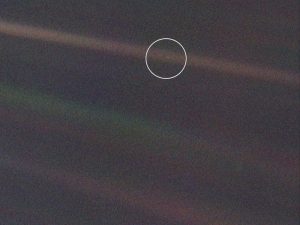
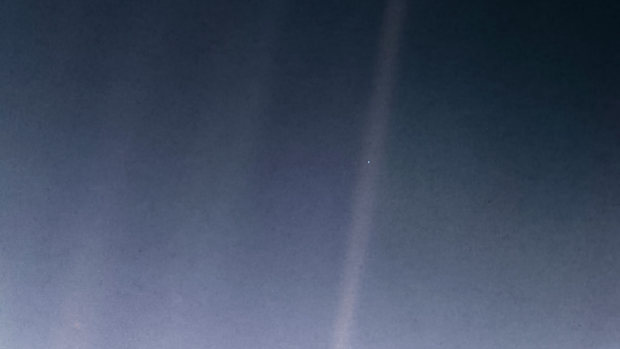
In February 1990, the unmanned space probe Voyager 1 was as far away from Earth as any man-made object has ever been. As it was drifting out of the solar system, some 3.7 billion miles away, its mission to study these outer reaches of space pretty much complete, it turned its camera back towards Earth to take one last photo.
At first glance, it’s easy to miss. It’s a few streaks of sunbeam dashed across the blackness of space. Then, as your eyes adjust, a tiny, pale blue dot emerges in one of the rays. “… a mote of dust suspended in a sunbeam,” as the astronomer and philosopher Carl Sagan described it.
“That’s here. That’s home. That’s us.” he said, “On it everyone you love, everyone you know, everyone you ever heard of, every human being who ever was, lived out their lives.”
Take a look at the image here… and below is what Carl Sagan wrote about it in his book The Pale Blue Dot: A Vision of the Human Future in Space.