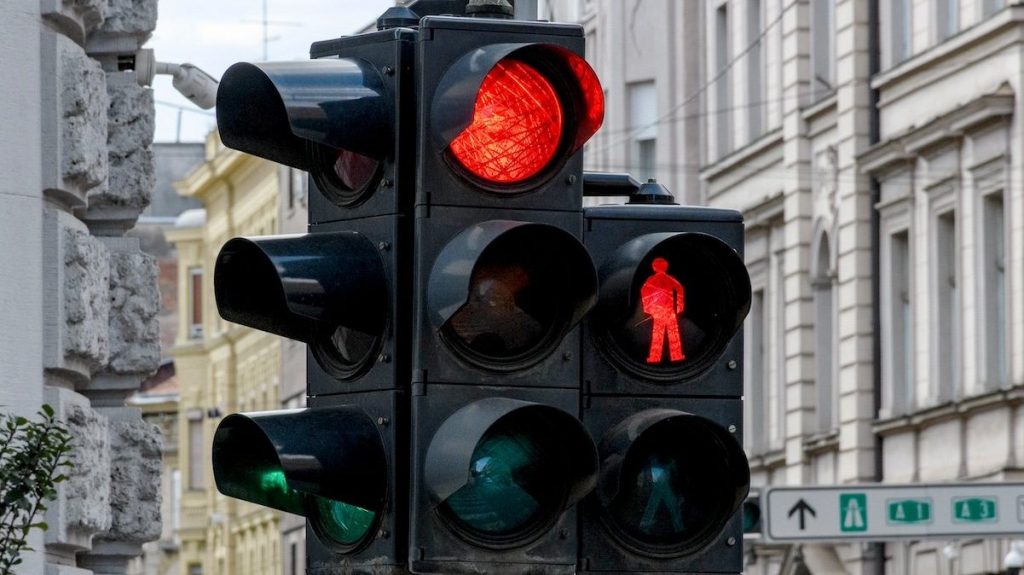
Sometimes, when I am driving home from hosting my late night Times Radio show, I hit a red traffic light at a roundabout near MediaCity.
I think you know where this is going. It’s 01:30. There is nobody around. The red light is for a slip road off the main dual carriageway. It isn’t a priority light during the day, it’s definitely not a priority light overnight. I once timed it at four minutes and twenty seconds on red before changing to green. Four long, precious minutes of my life. Just think of what I could do with them. I could have finally moved that tool box into the shed.
But I don’t reclaim those minutes. I stop. I wait. I sit in silence, in the dark, all alone while nobody passes in the other direction… and I wait. Because the alternative is the beginning of the end of civilisation.
Stopping at a red light is a universal rule. We all understand it, we all know why the rule exists, and we all give a little and earn a little from following it. It’s one of those small shared understandings that stitches the fabric of a society together.
But that fabric might be fraying.
The number of drivers going through red lights has risen by 61% in the last three years. 380 offences are reported daily. And that’s just the ones that get caught. More people are breaking the universal rule.
A couple of years ago we all took part in a mass experiment in social compliance. A new virus was spreading and, on the advice of scientists, our leaders changed the rules that govern our lives. They asked to stay at home and avoid friends and family. We sat and waited at a mass red light, knowing that if we jumped it we risked crashing into a virus, or crashing our virus into somebody else.
And, largely, with the notable exception of David Icke, people felt the measures were the right thing to do under the circumstances and followed the rules.
At the time, I was wondering what impact this might have on our relationship with authority. Would people become sick of being told what to do? Or was the widespread compliance proof that the story of our fracturing trust in institutions was overblown?
Since the pandemic, I have been journeying to the fringes of society to meet the people who have fallen off the edge of the mainstream. Last year I made a documentary about a community in Sussex who grew out of the anti-lockdown movement.
Its founders – husband and wife Matt and Sadie Single, and their friend Katy Jo-Murfin – are notorious activists against an education system they claim is indoctrinating children. They have carved out a new community for themselves, Hope Sussex, where they encourage parents to send their children to be home educated and taught an ‘alternative’ curriculum. Their critics claim Hope Sussex is an illegal school… a conspiracy school.
Hope Sussex is an extreme rejection of authority. Matt, Sadie and Katy-Jo almost completely refuse to partake in society as we know it. They were already down the rabbit hole when the pandemic came along, and with forced isolation, time online, and a sudden set of new rules… lots more people joined them.
And now, a new story may be emerging. Away from the extreme end of conspiratorial defiance, it seems more and more people are taking part in a much smaller act of rebelliousness – two-fingers to the system on their morning commute – and ignoring red lights.
Sociology has a handy term for this phenomenon: anomie, a kind of normlessness, where people begin to reject the normal rules and rhythms that keep us stitched together.
I wanted to know if this traffic light defiance was in fact an example of a fraying of the social contract, so I spoke to the social scientist Jack Katz, a professor emeritus of sociology at UCLA who has studied the psychology of driving.
“There were fewer people on the street in the pandemic for a while,” he tells me, “and speeding was remarkably increased. It’s kind of like when there were riots, like during the Rodney King riots in LA, all of a sudden there was no authority, and people started to drive on sidewalks, they would just make up the rules. They would drive over parking lots to jump intersections. They would just make things up.”
“People feel very proud when they can innovate the rules of society. And the pandemic and riots had something in common that, okay, something’s going on here that the usual system isn’t applying. Let’s make it up. When people start to make it up, it gets very anomic.”
But even if we are seeing a creeping normlessness, that wasn’t the story of the pandemic at the time. The story of the pandemic was populations rallying around a shared cause.
“Breaking the rules tends to make better headlines than observing the rules, and so stories of people plundering supermarket shelves for toilet rolls or flouting lockdown have filled the front pages,” say a group of social psychologists in their 2020 paper Together Apart: The Psychology of COVID-19, “Nonetheless, the overall figures show that very few people stockpiled scarce commodities. Equally, the great majority observed restrictions (indeed, far more than authorities in many countries had expected). And it was not easy. One analysis shows that, of the 92% of the UK population supporting lockdown, roughly half were suffering hardship as a result of the lockdown. It is no hyperbole to say that their behaviour has been heroic.”
And even when people did flex the rules, it wasn’t a disregard for them.
“One particularly telling study showed that the poorest people in Britain were three times more likely than the most affluent to go out to work (Bibby et al., 2020; Smith, 2020). But, crucially, there was no difference in their psychological motivation to stay at home. It was simply that they needed to go to work to put food on the table.”
It’s hard to believe that a 61% increase in running red lights is driven by practical necessity rather than a disregard for the rules, but there are lots of other possible reasons. Roads are getting busier, which means longer waits in traffic, which could be leading to more people sneaking through on amber but being caught by a red. In another story of our times, a survey by The Centre for Attention Studies at King’s College London found a majority of those they asked felt their attention spans had shortened in recent years. Could we just be… missing them?
Jack Katz tells me there may be something about the car itself that’s having an impact too.
“People are, through technology, increasingly aided in staying in their own world, in treating that car as an extension of themselves. They have all these communication possibilities, media possibilities. People stay in their own world and treat other people as part of the landscape that’s passing. There’s going to be a race between the technology facilitating that and the technology of cars that can control what you’re doing.”
My car has a sensor that beeps whenever I drift into another lane, and if I’m not indicating and if it thinks I’m doing it by accident, the car nudges my steering wheel back in the other direction. That’s a helpful bit of technology for somebody like me with ADHD, but it’s also a small loss of control. I feel a little humiliated that I got something wrong and the car had to intervene and take charge.
“We’re in a race now within technology when we’re just a passive recipient of the outcomes. The cars increasingly will brake for you whether you want to or not.”
And then you get to a red light. You sit there, in a machine that just humiliated you, that took a bit of autonomy from you, staring down another machine, its red light glaring at you, that’s also telling you what to do. Nothing is coming. It couldn’t hurt to skip it. I could reclaim a bit of my autonomy. Shake off the man, free myself from the shackle of the machines.
Except I don’t. I sit and I wait for four long minutes, adding my small stitch back into the fabric that holds us together.