Welcome to Fakerfield

When I reached for my phone on Friday afternoon, bleary-eyed from an all-nighter, it wasn’t the first time something I’d said at 3am had got me into trouble. This time, though, it wasn’t that I’d accidentally insulted my friend’s new partner after a few too many pints. My phone was buzzing from an exchange I’d had about the richest man in the world, with his politician of choice.
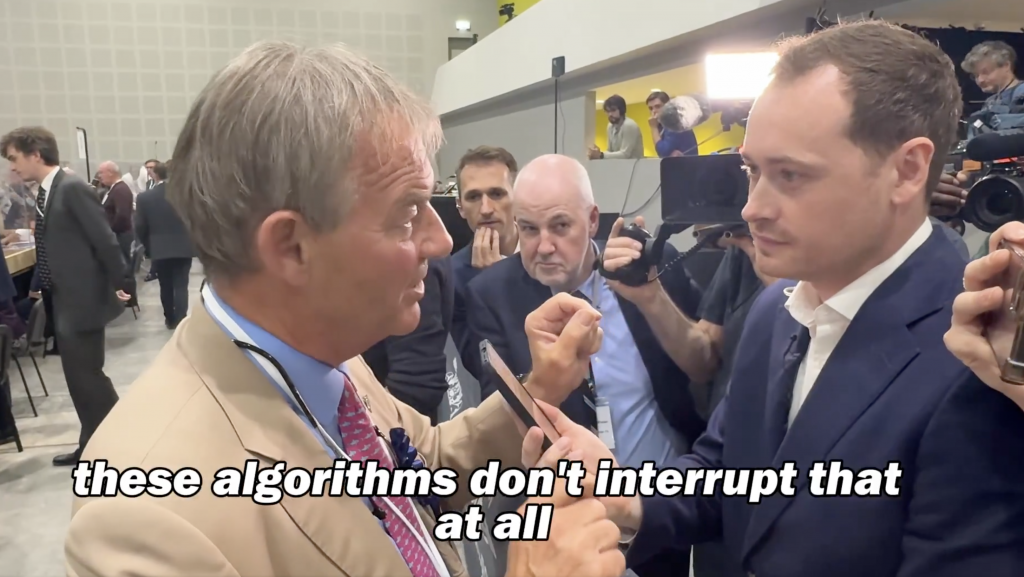
In the hall of a conference centre in Wigan, deep into the night, Rupert Lowe flashed past me in a flurry of cameras and microphones and journalists. His party, Restore Britain, had become an intriguing subplot in the Makerfield by-election. With Andy Burnham on course to beat Reform UK, and challenge Sir Keir Starmer for the Labour leadership, polls were suggesting a splintering of the right-wing vote and that a chunk of Reform UK voters drifting to Lowe’s Restore Britain could be the deciding factor. In the end, it wasn’t. But the fascinating dynamics of yet another split on the right had made Rupert Lowe a hot property for those couple of hours in the middle of the night.
I was jostling with other journalists to get a question in. One-by-one they asked about his fractious relationship with Nigel Farage, whether he’d do a deal with Reform UK, and his views on Andy Burnham. As it crept towards my turn, there was one thing I couldn’t resist asking.
In the last few years, I have written to you a lot about how our online lives are influencing the way we think, feel and vote – the disconnect between our real world and the worlds that are built for us online – and I had been thinking a lot about how social media was shaping this by-election.
Elon Musk, the tech oligarch owner of X, has thrown his considerable weight behind Rupert Lowe. His hard-right party, Restore Britain, are one of the main beneficiaries of an engagement based eco-system that often promotes the most extreme content. Some people argue Musk has his finger on the scales, and that it all amounts to something akin to foreign interference in British politics.
And so there I was, with one of the main characters in this fascinating story of a new age of influence, and I couldn’t resist asking him about it.
“Tech oligarch? No, no, no. He’s the most successful entrepreneur who has set up X as a free speech platform,” he barked at me. “What do you mean a tech oligarch?”
“Somebody who has a lot of ownership and control over the information ecosystem and, in a place like Wigan, that’s really landed. I’ve been speaking to people in Wigan the last couple of weeks and your message cuts through in an extraordinary way on platforms that promote it, and those platforms are often owned outside the United Kingdom.”
“Well, I think that’s palpable rubbish,” he snaps, “Elon Musk runs a free speech platform, and everyone says the algorithms help us. They don’t. Elon Musk is a genuine, principled free speech advocate.”
“Is he too involved in UK politics, though?”
“Hang on, hang on. Before you start jumping around like a jack-in-the-box. You’ve made various accusations that are quite offensive and wrong. So why don’t you just listen for a couple of minutes.”
Lowe leans in, the hum of journalists around me quietens in anticipation, “Okay, go ahead. I’m listening.”
“His platform is a free speech platform which actually allows those people who want to express freely what they think to express what they think. His algorithms don’t interrupt that at all. Indeed, he allows people to criticise himself on X and he doesn’t change the algorithm at all. So, he’s a highly principled, very successful, probably the most successful entrepreneur the world has ever seen. Why can’t you just celebrate that?”
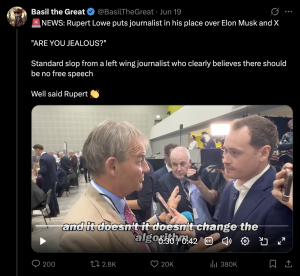
I grip my phone as I lean out of bed, watching the shaky footage from the night before, filmed and posted to X by a Restore Britain supporter.

“Rupert Lowe puts journalist in his place over Elon Musk and X. Standard slop from a left wing journalist who clearly believes there should be no free speech. Well said Rupert.”
If I am honest, I had a flicker of doubt. Was I too harsh? Did I get it wrong? But it’s a central plank of the populist shtick: discredit the media, make them second-guess themselves, discredit their scrutiny. I steadied myself and scrolled to the comments.
“I want to throw so many rights at this face that it will beg me for a left” said one account above a screen shot of my face. “All our rights will be taken by him” another commented.
My heart beats a little quicker as I stare at a picture of my face surrounded by violent rhetoric. But before I can worry about them turning up at my house, something catches my eye. The overwhelming majority of the accounts are nameless and faceless.
GenXDrowning. Basil the Great. Lord Worzel. LibertyLuxe. Lyn850937353369. Union flags and AI generated lions and cartoon rabbits make up most of their profile pictures.
When Rupert Lowe and Reform UK’s Zia Yusuf fell out last year, the online research firm Cyabra analysed the discourse as it played out on X. They found “a coordinated campaign promoting the official X account of Rupert Lowe, with 39% of the profiles commenting on his content classified as fake.”
“The campaign was highly synchronised and strategically executed,” their report claimed. “Fake profiles not only promoted Rupert Lowe’s image but also targeted Zia Yusuf, spreading similar narratives and exhibiting coordinated behavioural patterns across multiple conversations on X.”
An X pile on can leave you looking over your shoulder, but what if the people I am looking out for don’t exist at all?
Regardless, the posts about me seem to do well. Several of them get hundreds of thousands of views and tens of thousands of likes. When Rupert Lowe claims that X’s algorithm doesn’t get in the way of it being a free speech platform, he is wrong. If X didn’t have a weighting system, then maybe you could make that argument, but it does… and it suits Rupert Lowe very nicely.
An investigation by Sky News last year found that Rupert Lowe’s content was being disproportionately promoted. X isn’t a free speech town square, as Musk and Lowe claim. It’s a town square where some are handed a microphone and others are not.
Sky News set up nine brand new accounts. Three were set up to replicate somebody with left wing views, three with right-wing views, and three neutral. Over 60% of the political posts promoted to these accounts came from profiles categorised as right-wing, 32% came from left-wing accounts, and 6% came from non-partisan accounts.
The user profiles designed to be left-wing were shown roughly the same amount of left-wing and right-wing content, but only 14% of the political content sent to the right-leaning users was left-wing, and neutral users saw twice as much right-wing content as left-wing content.
It’s hard to say if Elon Musk does – or doesn’t – have his finger directly on the scales. The X algorithm is open source, but only partly. The Times’ Fraser Nelson wrote this piece about how it functions.
Extreme content is more likely to get engagement and, therefore, more likely to be promoted. That isn’t a revelation. It isn’t new, and, although more powerful and consuming, it isn’t a concept unique to tech platforms. But Musk’s finger may be on the scale in a more subtle way. The platform has been moulded around its owner by its users. Musk being so politically active may mean that the more you agree with him, the more likely you are to use his platform. Couple that with an exodus of left-wing users in protest at Musk buying the platform, and that gives disproportionate space and reach to right-wing content that mirrors his opinion. Those views are often extreme and laced with misinformation; the sort of content the platform’s algorithm loves. And right now, Elon Musk’s opinion is that Rupert Lowe is the only man who can save Britain. When Musk comments on Lowe’s tweets, the post gets a 5x boost.
That said, the Sky News investigation wanted to take the left-wing exodus into account. They took the 33 most prominent political figures promoted to the accounts they set up and compared how many of their posts they were shown against how many they’d made. If X really was a free speech platform, and the promotion of right-wing content was simply down to their being more right-wing posts, the two should in theory be closely matched.
For Conservative leader Kemi Badenoch, they were. Her posts made up 4% of the total sent, and 3% of the posts the algorithm chose to show the accounts.
Posts from Rupert Lowe came to 6% of the total sent by political accounts but made up 24% of the posts that reached the users.
Left-wing firebrand George Galloway had the opposite problem, despite also being a populist with extreme positions. His posts made up 13% of the total – the most of any single user – but only 3% of the posts the algorithm showed Sky News’ profiles.
This is also a lucrative business. As of May this year, Rupert Lowe has earned over £72,441 from posts to X. In April alone, he registered £10,000 in payments.
Rupert Lowe told Sky News: “Even a dinosaur like me understands that if content is engaging and popular, it receives more attention in the algorithm.” He added: “There is no conspiracy. It just turns out that British people enjoy some straight-talking from a politician for a change. Mass deportations are popular, and the algorithm picks up on that and rewards it.”
Whatever the truth of how the X algorithm is working, it provides Rupert Lowe and other right-wing content creators with an extremely powerful and lucrative reach.
Back in Wigan, you can feel it in the air. Conversations echo the most prominent talking points back to you: men of fighting age, mass deportations, Christian values, white replacement, civil war. In a car park in Ashton, a woman rages at not being able to get a dentist appointment, and how immigrants are clogging up the system.
Makerfield is 97% white, British born. You don’t have to be directly affected by an issue to feel strongly about it – “I am just concerned for the country,” says the woman when I point out the demographics – but the distance between how people feel, and their reality, is growing into a chasm.
But this new world isn’t just being forged on X. For towns like Wigan – and in by-elections like Makerfield – it’s playing most fiercely on local Facebook groups.
Did you hear the news about Andy Burnham’s wife personally benefiting from the Clean Air Zone her husband was going to introduce as Mayor? Or how about the time the Labour Home Secretary Shabana Mahmood went on a violent pro-Palestinian march?
They aren’t true, so probably not. Unless you live in Wigan, and you’re one of the 60,000 people in the local Facebook groups that the Social Market Foundation studied during the by-election.
The organisation analysed over 1,800 posts across four local Facebook groups, before and during the by-election. They found that posts containing misinformation jumped from 4% to 16% during the election period, and they were the posts getting the most engagement and reach. In one group, 5 of the top 10 posts were misinformation. Half of them.
I wanted to know who these people were, so invited Theo Bertram – the director of the Social Market Foundation – on to my Times Radio show.
“Sometimes it’s ordinary people who are sharing a view, even if they don’t know it’s misinformation. Sometimes it’s people who are deliberately amplifying something that they know to be misinformation.” Fraudsters and foreign states. “Sometimes it’s people who are responding to a thing that they disagree with or they believe is misinformation.”
That’s another problem with an ecosystem that boosts based on engagement – every effort to fact check or correct or argue nudges the lie to a bigger audience. But the truth is, it’s hard to know where it’s coming from, unless you are the tech company.
“We can’t say, from where we sit outside of the tech companies, what those things are. But the tech companies themselves, they can and do see that stuff. But they tend to focus on what they call coordinated inauthentic behaviour. That’s only really done at national elections,” says Theo, who should know, having been an executive at both TikTok and Google, “and so when you have this sort of local news groups, local information, that’s where we’re quite vulnerable.”
Similar research during the Gorton and Denton by-election found misinformation targeted at Labour, Reform and The Greens. In Makerfield, it was entirely aimed at discrediting Labour.
For a lot of people, this is how they get their news. It shapes how they think, feel, and vote.
Except, it seems, it didn’t. You might have noticed that the target of the misinformation, Andy Burnham, won – big – with 54.8% of the vote.
If this sort of misinformation is warping our sense of reality, creating an alternative version of the world, blurring the lines between truth and fiction, and upending democracy en route… in Makerfield, it didn’t seem to work. Elections can be skewed by online misinformation, but they can also be reality checks. There will be thousands of people who were genuinely shocked that a majority of their neighbours voted for Andy Burnham.
His victory is complex – he is hugely popular in the area, much punchier online compared to other mainstream politicians, and his campaign made a similar anti-establishment argument to the one that does so well in online spaces – and it was as national an election as it was local, with endless national media coverage. But the more local and targeted the misinformation becomes, the fewer credible outlets there are to cover the facts, the more effective its impact.
“What we have seen in the local elections is local councillors lose their seats directly as a result of misinformation,” adds Theo, “where we saw that the party had a general [national] swing – but these individuals who were the victims of misinformation were voted against.”
Like in Oldham, where last year I wrote about the young councillor Sean Fielding, canvassing a semi-detached house in his ward of Failsworth when an elderly couple answer the door. They remember him growing up in the area and delivering their local paper. They’ll be voting for him, they say. Sean knocks next door. A woman in her 40s. She won’t be voting for Sean, she tells him, because he’s complicit in the cover up of a dangerous cartel of sexual abusers.
It’s a baseless theory – injected into their veins through local Facebook groups – that has poisoned Oldham’s politics. People living in the same street, living in completely different realities.
Raja Miah is a local activist, who following a run-in with Oldham Council began to claim that political leaders were covering up the existence of grooming gangs. While the issue of grooming gangs in northern towns is real, and raw – and accusations that they weren’t taken seriously enough are credible – an official review found no evidence of a cover up in Oldham, and Sean certainly played no part. It didn’t matter. The theory stuck. It grew on local Facebook groups, has upended political discourse in the town, and led to the unseating of three council leaders and the firebombing of one of their cars.
Sean lost his seat to a man called Mark Wilkinson, the admin for the Failsworth First Facebook group, who shared Raja Miah’s theories. In the years since, Sean has left Oldham. “I am no longer safe in my town,” he says.
Tech companies use broad brushes to tackle misinformation, says Theo. “They do a good job at elections. But so far they have really concentrated at scale, because that’s what tech companies do. So what they’re looking for is misinformation that’s global. What they’re not picking up is what some local councillor in Oldham may or may not have done. And in their view, they probably see that as too small. 10 years ago, that would have been an acceptable omission. But today, if you imagine that there are states that want to spread disinformation, previously they would have had to have lots of people trying to do that for them. Now they can use AI bots, which means that they can do it at scale, and very locally as well.”
Local Facebook groups aren’t thriving in places like Wigan and Oldham by accident. They’re filling a gap in the market.
“When there is no local newspaper ecosystem in an area, local misinformation is three times higher,” says Theo, “When there is a local newspaper ecosystem, local misinformation is half of what it normally is.”
Technology has destroyed the business model and income of local news, and with it the journalism that would separate fact from fiction in local politics. Instead, that income is going to the very tech companies where misinformation thrives.
And, in the case of X, who reward the most engaging posters on their platform… the money goes to Rupert Lowe.
This article was first sent as a newsletter – joins the hundreds of others and subscribe below.