
Just a heads-up: this article has graphic detail that you might find upsetting.
Watching the news of murderer Christa Pike’s execution has been conflicting and, as it became clear the lethal injection had failed, leaving her grunting on the gurney, pretty harrowing.
In 1996, when Christa was 19, she was sentenced to death for the murder of 18-year-old Colleen Slemmer. Christa had become convinced that Colleen was trying to steal her boyfriend, and so hatched a plan to lure her to the woods.
Both Christa and her boyfriend, Tadaryl Shipp, tortured Colleen. They beat her and slashed her and left her begging for her life.
It was a brutal brain injury that killed her, that took away her dream of being a computer scientist, that snatched a daughter and a sister from a loving family.
Tadaryl carved a satanic symbol into Colleen’s dying body. Christa walked away with a chunk of her skull in her pocket.
Tadaryl was given life in prison. Christa was sentenced to death. Thirty years and several failed legal challenges later, Christa was taken to the execution chamber last week, strapped to the bed and injected with a lethal poison.
It didn’t work. Witnesses describe listening to Christa grunting behind a drawn curtain. Eventually, she was taken to hospital in a critical condition… but alive. In the days since, her lawyers say she has made a remarkable recovery. At the start of the week, she was presumed brain dead. On Tuesday, she spoke again for the first time. On Friday, she walked.
Her lawyers say she is confused and angry. It seems most people involved – not least Colleen’s family – feel the same.
For the journalist Helen Roberts, watching the news has been surreal.
Many years after the murder, and many years before her planned execution, in the endless days of solitude and confinement, Christa did an interview with Helen for a famous women’s magazine.
The first thing she noticed when she arrived on death row was the smell.
‘It was pungent – a strange mix of barbecue turkey cooking and strong bleach. The type of smell you might recognise in a hospitality kitchen, when food and cleaning products mingle,’ she wrote in The Independent last week.
The second thing she noticed – once she had positioned herself on the other side of the secure glass – was how well kept Christa appeared to be. When Helen commented on how she looked, Christa seemed thrilled. It was like her imperfect curls and make-up were the one thing she had some control over, looking and feeling feminine in the clinical environment of a sanitised prison. It was clearly pleasing to be seen as a person after a decade as an inmate.
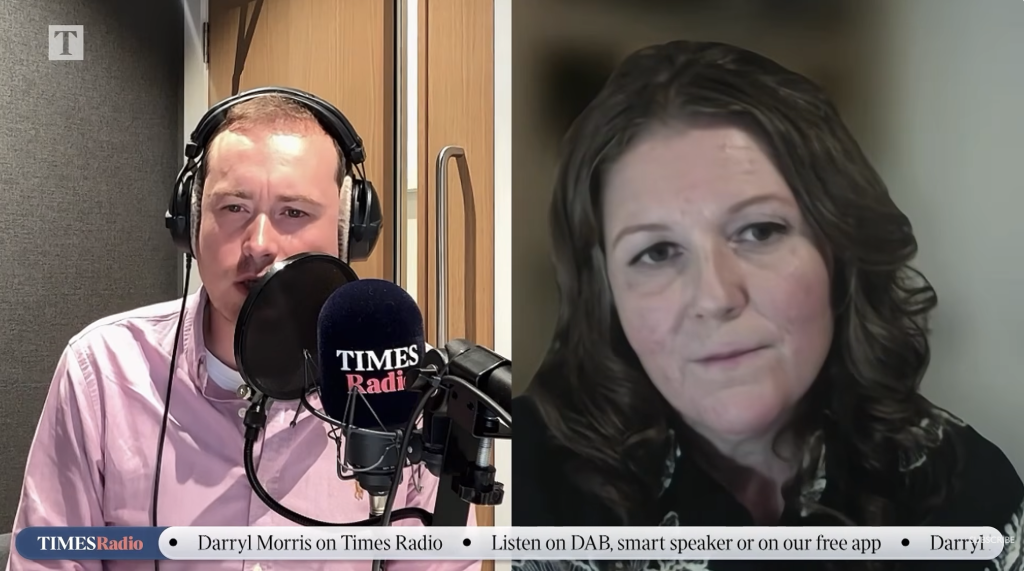
“It quickly became apparent that she wasn’t the monster you might imagine,” Helen told me on my Times Radio show this week, “for someone to have done such a horrific crime, she seemed capable of having an ordinary conversation. We both had curly hair. We bonded a bit over that. She would order her toiletries from the prison catalogue. I was there as the real life editor of More magazine, which was a popular women’s magazine back in the day. I think she quite liked that I was from a female magazine.”
Then Helen asked Christa about the murder.
“She was very matter of fact about it. I don’t know what I expected. I’d never interviewed anyone on death row. But there were no particular emotions. She had been in prison for eleven years by this time, so I think she would have gone through a lot of processing, a lot of counselling, a lot of getting to know herself and understanding what she did. Maybe the emotions had passed or maybe she’d cried all her tears.
She did say that she is sorry for what she did, but she can’t turn back the clock. There’s nothing else she can say to compensate for what she did.”
Helen found Christa to be relaxed and personable, but could she have been being manipulated by a psychopathic killer attempting to control the narrative?
There is one fairly consistent theme amongst the complicated people I spent time with myself, from far-right extremists to the man who claims to be God; they’re quite charming. Occasionally, I have had to catch myself from falling into a friendship with somebody I should be studying as a journalist. It’s easy to do. They’re very good at it.
An answer may be in Christa’s backstory of abuse and neglect. Helen found that her childhood and adolescence had been one long safeguarding failure.
“The crime she committed was brutal, but it’s the girl before the crime that has hit me emotionally. She said to me, ‘my life was bad before I even realised it was bad.’ She was severely neglected by her mother. I have read that her aunt went and visited her once and saw her crawling through dog faeces. Her younger years were just brutal.”
Christa talked Helen through several experiences of sexual abuse at the hands of neighbours and strangers. It feels impossible to excuse the brutal torture and murder of a defenceless teenager, but her lawyers have argued that Christa’s childhood should offer, at least, a mitigating factor. Did she need to be sentenced to death – especially as her boyfriend, just a few months younger, was spared?
“If she had been given the right support, the right adults to care for her, I believe her life could have been very different.”
Helen was keen to humanise Christa, and she is a human after all. But featuring Christa in a magazine article is controversial in itself. I couldn’t help wondering if Christa was enjoying the publicity. She was being given a chance to write a different version of history, or at least contribute to it, and maybe she was taking pleasure in the notoriety.
“Weirdly, she explained that when she was going through the trial, she wasn’t accepting the magnitude of the situation. She did admit to me that she quite enjoyed the attention. So that brings up questions about her mental state and her maturity at that age.”
By the time of Helen’s interview, Christa had been alone on death row for eleven years. “She would have enjoyed meeting anyone. However, I do believe that as a journalist, we’re there to tell stories that the public don’t have access to. In a way, thank goodness we did have some insight into that side of her in 2006.”
Colleen Slemmer’s mother, May Martinez, says she feels her daughter’s story has been drowned out in the coverage.. “The criminals get so much attention. Why?” she told local broadcaster WBIR. “She has been lost in this … she’s been forgotten.”
****
The case has sparked a debate about the use of the death penalty in America. This has clearly been a disaster for everyone involved. As well as Christa’s execution being an example of the risks, it feels like a reminder that it may be better to separate ourselves from those who kill. Christa had no right to take Colleen’s life. Should we really have the right to take hers?
Incidentally, the US administration’s response to this event has not been contrition or reflection. This week, US Defence Secretary Pete Hegseth confirmed that the execution of former Army major Nidal Hasan – who shot dead 13 fellow soldiers in 2009 – would be live-streamed. It’ll be America’s first public execution in nearly a century.
“She deserved to be in prison,” Helen says. “She committed a horrific crime and she had to pay the consequences. But I feel that if someone had stepped in during those early years, then it’s possible her life would have been different. It’s the girl before the crime that I pity.”
You can watch the full interview with Helen Roberts right here.