Darren doesn’t much care for people like me. He doesn’t trust the mainstream media, and although he was happy to have a chat with me, he did wonder how I might misrepresent our conversation.
I met Darren on the terraced street he calls home, in Gorton, in Greater Manchester. At the end of the street a large blue billboard clings to the side of one of the houses. It reads: Are you lost? Jesus said, I am the way, the truth and life. Free bible? Go to hopebytheroadside.com.
In a few weeks time, the people of Gorton and nearby Denton will pass judgement on how much faith they have in the system, in what could be a highly consequential by-election.
It’s hard to tell a coherent story about this part of the world. Gorton and Denton is an odd constituency, a patchwork of lots of different demographics, incomes, and experiences. The academic Rob Ford, professor of politics at the University of Manchester, described it as a tale of two Manchesters. It’s a patchwork of working-class white people, a large-ish Muslim population, a chunk of university students and graduates. The area has been a Labour stronghold since the dawn of time – and while Andy Burnham could well have won it for them, a threatened Labour leadership didn’t allow him to stand, and with loyalties drifting this race is wide open. Any one of Labour, Reform, or the Greens could benefit, or lose out, or a bit of both. It’s as unpredictable an election as I have ever known. If the story of British politics has become about fragmentation, this is it in election form.
A gentrified area with houses worth close to a million pounds sits just a few streets away from the red brick terrace where Darren lives, where he describes the houses as buy-one-get-one-free.
It was because Darren didn’t trust me that I wanted to speak to him the most. Darren gets his news through social media and YouTube. He likes Tommy Robinson and watches his videos a lot. And I was so keen to speak to Darren because I wanted to know what he thought of one of the candidates.
If you have spent any time online, you will know Matt Goodwin. Matt is a former academic, who used to research the populist-right. There is a viral clip of Matt that often does the rounds on X, where he’s debating far-right activist Tommy Robinson. He’s explaining to Robinson why he believes his movement is a threat to liberal, representative democracy. Matt Goodwin is now the Reform UK candidate. Last week, his campaign was endorsed by… Tommy Robinson. One Labour supporter I spoke to recently was shocked to learn of the political journey Matt had been on. They’d once bought tickets to see him give a talk about radicalisation. Now, they said, he’d been radicalised by his own research.
Matts rebrand has benefited from an information eco-system which rewards populist politics – big pronouncements, emotive and engaging content. His comments that former Prime Minister Rishi Sunak, born in England to parents of Indian heritage, can’t be English were deeply controversial. But more importantly, they travelled. It’s the sort of content that racks up large numbers of views. Clicks, cash, and an intoxicating injection of dopamine. He has been embraced by a new community, found a sense of purpose in his new pursuit, and is being richly rewarded by huge engagement.
I wrote a lot about the mechanics of this last year. You can read more here.
If Matt Goodwin is a key character in an online drama that has us all hooked, now he’s about to enter the real world. The cold, hard reality of an election. And for Reform, this is a risk. They don’t have much margin for error in a constituency populated by as many people who, if we judge by demographic, could hate them as much as love them. Just a handful of people put off by a controversial character could tip the balance. They will have to do well, very well, amongst their core audience. People like Darren.
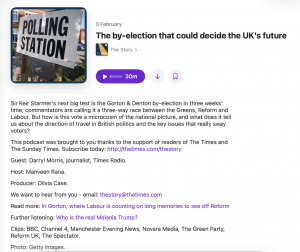
So… what does Darren think of them, and how much does he know of Matt Goodwin? This is a crucial question, and one that I ask him in today’s episode of The Story podcast from The Times and The Sunday Times.
I also explore how much Andy Burnham is looming over the Labour Party here, and if the Greens are getting the support they need to be the genuine challenger in a stop-Reform campaign.
A few streets from Darren, I meet Dell. Dell is a Labour man, always has been. He doesn’t feel they have been given a fair chance yet and can’t vote Reform “as a man of colour.” He is, though, thinking about voting Green. He wasn’t happy with the way Labour handled the situation in the Middle East, and wonders if the Greens deserve a go. But more importantly for him, he’ll do whatever it takes to keep out Reform.
The results of by-elections can be over-read. They seem like seismic events in the moment, when the morning news cycle is dominated by who is up and who is down. A kicking for the government, or the failure of the opposition to make gains, can feel existential in the heat of the battle. Then, as the days and weeks pass, things settle down and it fades into the distance. This one may follow the same pattern… but what Darren and Dell decide to do could change the direction of British politics in more subtle ways.
If the Green Party win, if they emerge as the force around which a ‘stop-Reform’ coalition is built, it shatters the story Keir Starmer wants to tell: the next few years, and the next election, are about Labour vs Reform. It’s the strongest hand he can play – as somebody who presents himself as the antithesis of Nigel Farage – to stay in the fight and stay in Downing Street. Zach Polanski has a similar problem if Labour win out, although the stakes are lower. And for Nigel Farage, defeat halts a momentum that seems to be slowing in the national polls too. The narrative shifts from Reform on the rise, to Reform have peaked.
This by-election may not sink any of their ships, but it could alter their course. It really could be the by-election that changes British politics, and right now, in my experience, it’s impossible to say how it will go.
Listen to Darren and Dell in their own words, and what else I found in Gorton and Denton, on today’s episode of The Story podcast from The Times and The Sunday Times. Just click here.