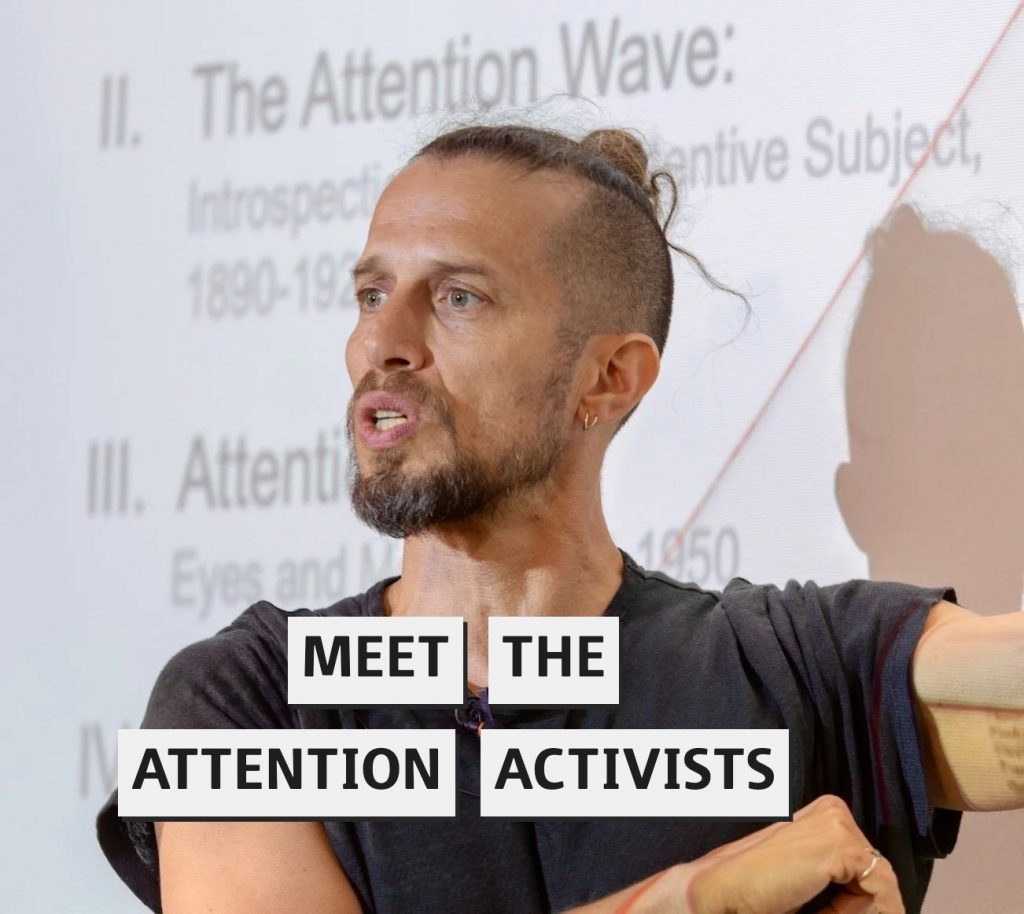
Professor D. Graham Burnett would like it, too. Graham is an historian of tech and science… and through his research has become so passionate about reclaiming our attention from the grip of tech giants and addictive digital media that he has started a new movement. Alongside some colleagues, friends, artists, activists and other researchers… they set up Friends of Attention.
They make an interesting argument: our attention has been so successfully commoditised that we have lost control of it. We’re no longer in charge of our senses. A basic human function has been hijacked, and we need to reclaim it. Graham says we are being fracked. Like companies drill for lucrative oil and gas, we’re being drilled for our attention, and our attention is being monetised. Human fracking, he calls it.
And our attention is extremely big business. Amongst the six largest companies in the world are Apple, Google, Microsoft and Amazon. All companies whose business model and vast profits rely on capturing and monetising our attention. The other two in that top six are NVIDIA and TSMC, the people who make the chips that power the technology that captures our attention.
A few years ago, I made a documentary for the BBC about how some of these companies capture and keep our attention, called Dark Patterns. These are the tricks and techniques that websites use to make us click, buy and subscribe to things. I start the programme with the example of Amazon, and a Prime Subscription. Have you ever tried to cancel it? At the time of making the programme, it was a bloody nightmare. You had to click through bits of the website that seem completely unrelated, a complex maze of pages, and then eventually you had to… call the company. Whereas if you wanted to buy something using Amazon, you can famously do it in… one click.
This technique is called a Roach Motel. It’s designed to make it as easy as possible for you to do something that makes the company money, and really difficult to do something that harms them. Since I made that programme, some jurisdictions legislated against this type of website design and cancelling has become a bit easier. This example is fairly simple, but this documentary was about exploring the power those people who design our online lives have to influence us, and how they use it.
And this isn’t a fair fight. Companies spend fortunes on researching how to capture and hold our attention. They’re able to do real time research on how we respond to certain language, colours and noises, how it makes us feel and behave, and alter their product accordingly. Companies aren’t just hoping for the best, they’re employing the best. Some of the finest minds in behavioural science are working tirelessly to hook you in, keep you, and persuade you to spend.
Most of this isn’t unfamiliar to you, is it? It’s an experience we live with every day. But we’re probably less familiar with how we got here. To understand that, Graham tells me, we could start where most innovation starts… in a war.
In the 1940s, the British psychologist Dr Norman H. Mackworth was recruited to help understand how Royal Air Force pilots were interacting with the radar systems they were using to detect German U-boats under the sea. New air-to-surface-vessel radars were allowing the RAF to scan the waters below them and detect hidden submarines. When a sub was detected, it registered as a small blip on a screen in the cockpit. This new technology was genuinely revolutionary, and incredibly expensive, but relied entirely on the person in the cockpit paying enough attention to notice the blip.
And so Dr. Mackworth set about an experiment. He designed a clock with a second hand that would occasionally skip forward a few seconds. He asked subjects to record when they noticed the clock skip. Unsurprisingly, the longer they looked at the clock, the more they missed the skips. This became known as ‘the vigilance decrement’, and has formed the back bone of a lot of research into human attention ever since.
In the meantime, the scientists needed to find ways to keep those RAF pilots focused on that screen. And so began experiments with various stimulating buzzers and alerts, types of displays, amphetamines and more refined metrics for judging how and why a human stays focused on a machine.
Shortly after, another psychologist at the University of Cambridge picked up the baton. Donald Broadbent’s work focused on the number of commands one Navy officer could process at one time. If the officer was receiving multiple reports, from multiple aircraft, how they processed that information could become a life or death equation.
Donald Broadbent’s research presented human attention as a filtering system, and he designed diagrams of a series of valves and tubes. Everything comes into our central tube, but only some of it filters down the valves to the brain. Developing techniques to get the right information to stick, to make its way down the valves and into the mind, became an industry that hasn’t just kept the RAF and the Navy engaged… but you, too. In Casinos, for example, where Mackworth and Broadbent’s research has been used to keep gamblers attentive to highly addictive slot machines, and then at the birth of the internet, on websites and apps. And now the most powerful and addictive machine many of us will ever encounter, that one in our pocket.
It’s this mechanical understanding of our human attention – and it’s commodification for profit – that Professor D. Graham Burnett objects to the most. It’s why he is pushing back. His movement is calling for a combination of resistance and regulation.
This week, I spoke to him on my Times Radio show to understand how – and to ask if this is really the right diagnosis. Haven’t these technological advancements also helped humans, as much as they have harmed us? Do we underestimate the power of free will? Isn’t this a luxury, those who are able to resist technological change with little consequences will be fine, but most of us are reliant on machines and to walk away would be a costly commitment? Wouldn’t it be better to embrace it, use it, work with it, especially when you consider how outgunned a group of ‘attention activists’ are against an industry powered by the six largest companies in the world?
Listen to my chat with Professor D. Graham Burnett here.