Newsletter: The Pale Blue Dot

It was a couple of hours before Donald Trump promised to bomb Iran back to the Stone Age that humanity did something extraordinary.
Under an eruption of blinding white steam and churning orange fire, hundreds of tons of metal and four intrepid humans were thrust into space.
The launch of Artemis II is the culmination of decades of toil and strife, of ambition and expectation, of engineering and scientific progress. It is the manifestation of a renewed desire for humans to step out beyond the world we know, into the darkness of the solar system. Artemis II will orbit the moon and then come home. The next iteration will land on the surface of the moon. From there, the plan is to establish a base. It’ll be used to conduct scientific experiments and as a hub for further exploration to places like Mars.
These two extremes of the human condition – our commitment to exploration, and to killing each other – happening in tandem reminded me of the greatest picture ever taken.
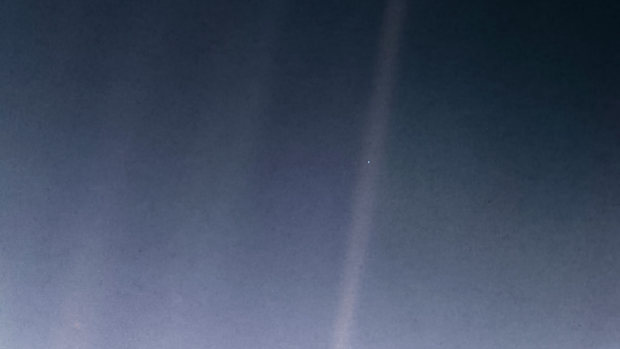
In February 1990, the unmanned space probe Voyager 1 was as far away from Earth as any man-made object has ever been. As it was drifting out of the solar system, some 3.7 billion miles away, its mission to study these outer reaches of space pretty much complete, it turned its camera back towards Earth to take one last photo.
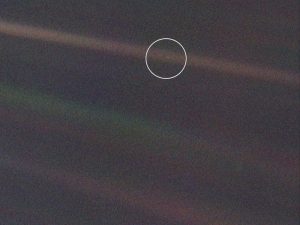
At first glance, it’s easy to miss. It’s a few streaks of sunbeam dashed across the blackness of space. Then, as your eyes adjust, a tiny, pale blue dot emerges in one of the rays. “… a mote of dust suspended in a sunbeam,” as the astronomer and philosopher Carl Sagan described it.
“That’s here. That’s home. That’s us.” he said, “On it everyone you love, everyone you know, everyone you ever heard of, every human being who ever was, lived out their lives.”
Take a look at the image here… and below is what Carl Sagan wrote about it in his book The Pale Blue Dot: A Vision of the Human Future in Space.
 

“From this distant vantage point, the Earth might not seem of any particular interest. But for us, it’s different. Consider again that dot. That’s here. That’s home. That’s us. On it everyone you love, everyone you know, everyone you ever heard of, every human being who ever was, lived out their lives. The aggregate of our joy and suffering, thousands of confident religions, ideologies, and economic doctrines, every hunter and forager, every hero and coward, every creator and destroyer of civilization, every king and peasant, every young couple in love, every mother and father, hopeful child, inventor and explorer, every teacher of morals, every corrupt politician, every “superstar”, every “supreme leader”, every saint and sinner in the history of our species lived there – on a mote of dust suspended in a sunbeam.
The Earth is a very small stage in a vast cosmic arena. Think of the rivers of blood spilled by all those generals and emperors so that, in glory and triumph, they could become the momentary masters of a fraction of a dot. Think of the endless cruelties visited by the inhabitants of one corner of this pixel on the scarcely distinguishable inhabitants of some other corner, how frequent their misunderstandings, how eager they are to kill one another, how fervent their hatreds.
Our posturings, our imagined self-importance, the delusion that we have some privileged position in the Universe, are challenged by this point of pale light. Our planet is a lonely speck in the great enveloping cosmic dark. In our obscurity, in all this vastness, there is no hint that help will come from elsewhere to save us from ourselves.
The Earth is the only world known so far to harbor life. There is nowhere else, at least in the near future, to which our species could migrate. Visit, yes. Settle, not yet. Like it or not, for the moment the Earth is where we make our stand.
It has been said that astronomy is a humbling and character-building experience. There is perhaps no better demonstration of the folly of human conceits than this distant image of our tiny world. To me, it underscores our responsibility to deal more kindly with one another, and to preserve and cherish the pale blue dot, the only home we’ve ever known.”
A few years ago, I made a documentary for the BBC World Service about how the Pale Blue Dot came about. I spoke to planetary scientist Candice Hansen, who worked on the Voyager programme and was one of the first people to see the image Voyager 1 sent back. It’s only ten minutes, and well worth your time. You can listen to that by clicking here. 
Carl Sagan was critical of NASA’s decision to retreat from exploring the Moon after the Apollo programme ended. He was one of the most passionate and articulate defenders of the idea that space exploration is intrinsically linked to the progress we make down here on Earth. That pitting progress on Earth against progress in space is nonsense. It is not a zero sum game. They are one and the same. Space exploration has turbo charged our understanding of our own existence, and helped us fix problems from climate change to cancer. The cover art for the first edition of his book on the Pale Blue Dot depicts some sort of human base on a moon-like bit of rock, somewhere beyond Earth. As Artemis II takes the first step towards a human base on the moon – and as Iran and the US trade potentially existential blows – I wondered what Sagan would make of it all.
He also knew how much of a joint enterprise space really is. We like to think of space exploration as being driven by competition, and in some ways it is. It’s true that competition forces innovation, and of course the race to the moon in the 1960s was defined as a race between communism and capitalism. And yet, if you dig a little deeper into the space industry, you will see a completely different story. Countries, continents, work together. Space agencies share data. Astronauts coexist on the International Space Station. Russians working with Europeans, working with the Chinese, working with Americas, working with Indians. The finest minds in science and engineering, working towards something bigger than themselves, bigger than the borders into which they were born, etched into this “mote of dust suspended in a sunbeam.”